 Solutions Overview
 Managed IT Services
 Cloud Services
 Azure and M365
 Security Services
 Application Development
 IT Consulting Services
 AI Strategy Consulting Services
 Network Services
 Collaboration & Communications


Why a Working Azure Environment Still Deserves a Health Check
Azure environments change one reasonable decision at a time. An admin role granted for a project and never removed. A backup scheduled but never tested. A machine resized to fix a problem and never revisited. Resources left running after a project ends. A service you rely on approaching a Microsoft retirement date. None of this stops the environment from working, which is exactly why it goes unnoticed. Over time, these small gaps add up, and questions that should be easy become hard to answer with confidence: Is access tighter than it needs to be? Could critical workloads recover the way the business expects? Are we paying for things we don’t use?
The Standard Worth Measuring Against
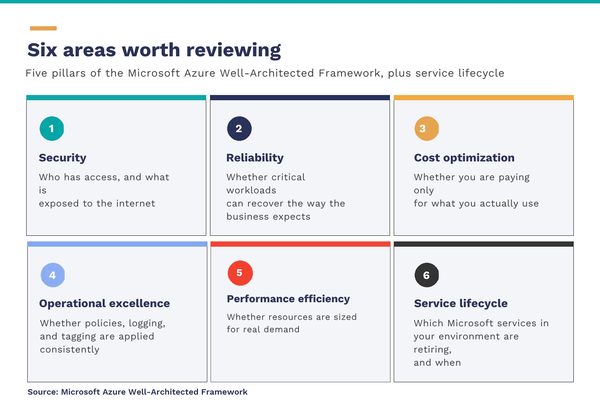
Microsoft publishes its own definition of a well-built environment, the Azure Well-Architected Framework, and updates it as services and best practices change. Its five pillars, plus service lifecycle, give you six areas worth reviewing on av regular rhythm.
What You Can Check Yourself
Three tools included with Azure are worth opening this week. They give you the evidence. The harder part is deciding what matters most in your environment.
.png?width=600&height=337&name=Page%202%20%E2%80%94%20Cropped%20(1).png)
What a Useful Health Check Gives You
Whether you run it internally or bring in an outside view, a good review should be:
- Grounded in Microsoft’s standard and your own Azure data, not opinion.
- Low-risk: read-only, nothing installed, nothing changed.
- Ranked, not listed: prioritized by business impact and effort.
- Written for two audiences: a plain-language view for leadership, detail for the technical team.
- Honest about savings: shown in dollars as identified savings, not guarantees.
How the ITW Azure Health Check Works
The ITW Azure Health Check was built to those standards. It doesn’t uncover information hidden from Microsoft’s tools. It turns the data your environment already produces into a ranked plan and a clear explanation of where you stand.
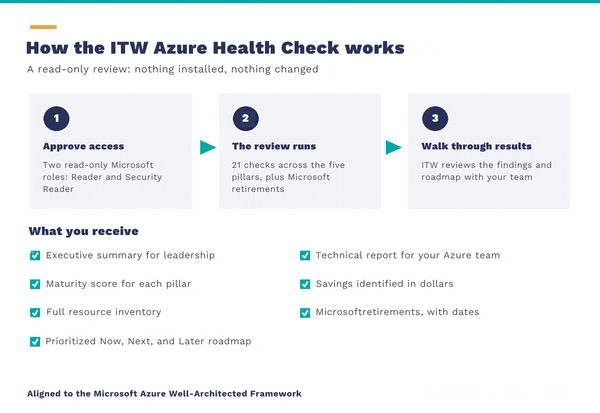
Your team can act on the roadmap internally, or ITW can help. No further commitment is required.
The Bottom Line
Every Azure environment changes over time. The teams that stay ahead review against a consistent standard, on a regular rhythm, and act on what matters first. A good health check replaces “we think we’re fine” with evidence and a plan.
See where your Azure environment stands.
Back to blog